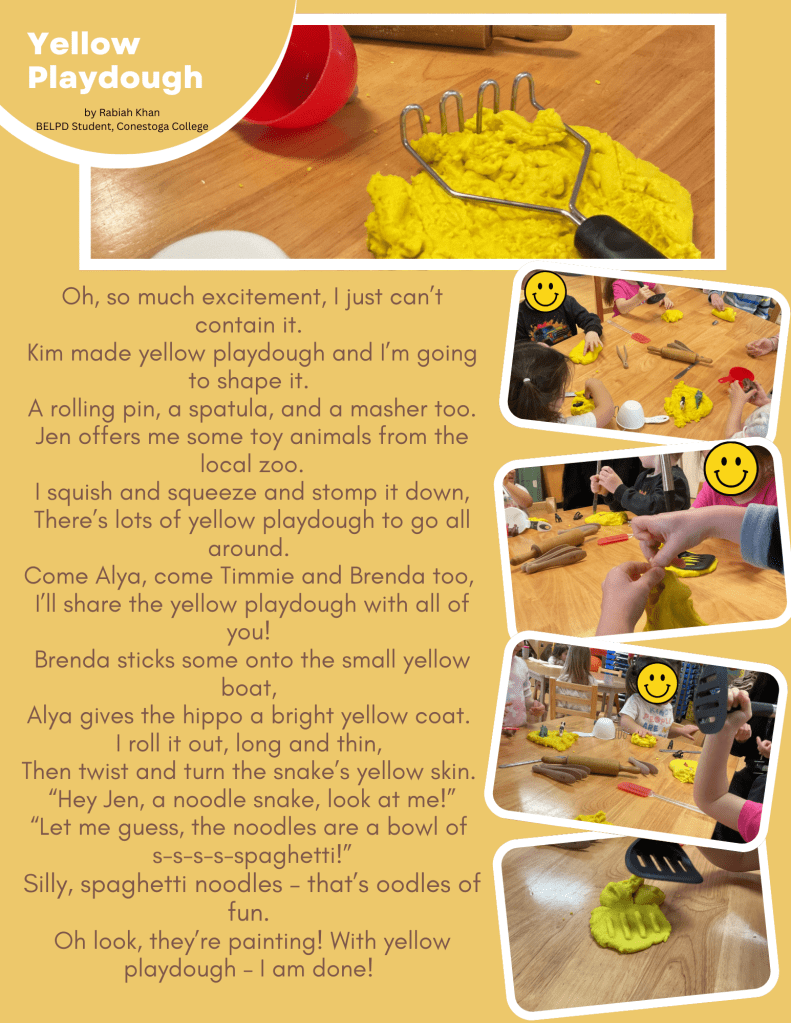
Artifact 1: Yellow Playdough Poem
Playing with playdough is a favourite activity amongst the preschoolers at my placement this term. Educators make their own playdough on site, often involving the kids in the process. This particular week, the kids had helped to make yellow playdough. In the mornings, educators will often ask those children who come in early what activities they would like to do. Milo, a three-year old, chose to play with yellow playdough. I helped the educator set the playdough table filling it with the usual tools, rolling pin, plastic knives, spatulas, cutting tools and different types of cutters. One of the educators, Jen, offered some zoo animals and some boats as well. I, too, sat at the table with Milo and his peers just to observe their play and how they engage with the playdough. I took notes of the whole play episode, the conversations that took place and the children’s interactions with each other and with the playdough. The conversation between Milo and Jen regarding the ‘noodle snake’ lingered in my head, bringing a smile to my face. As the play episode replayed in my head, I was inspired to document it as a poem. Once I had written the poem, I shared it with the educators and Heidi, my supervisor. They really enjoyed it and thought it really captured the play episode and interactions from Milo’s perspective in a profound way. We had not taken any pictures in the morning so the educators set up the playdough in the afternoon so I could take pictures to go along with the poem.
Documentation helps to capture episodes of play and learning making it visible for parents, students and educators. When shared with parents, documentation offers an insight into their child’s activities, providing them with information to connect with their child as they inquire about their day. This builds a home-school connection that helps to foster a sense of belonging and well-being while engaging parents’ in their child’s learning journey. After this Yellow Playdough Poem was shared with parents, Milo brought in blue playdough that he had made at home with his mom and sister. Milo’s Mom had reached out to ask for the playdough recipe and they had made a batch over the weekend. On Monday, Milo was so excited about showing and sharing his playdough with the educators and his peers. With Milo’s help, we set up the playdough table, choosing elements such as dolphins, sharks, fish and foliage to make an ‘underwater theme’ to compliment the vibrant blue of his playdough. As other children joined him at the table, Milo excitedly shared that he had made this playdough at home with his mom and sister.
My field placement center implements a child-led pedagogical approach, offering invitations and provocations based on the children’s interests and inquiries. The Yellow Playdough Poem documentation offers a snapshot of the children’s interest in playdough and how they engage with it. This documentation can be used by the educators in planning future activities and scaffold children’s learning based on their interest in sensory and hands-on play. Offering other mediums, such as slime, clay, oobleck and goop, or adding other textures like sprinkles, little beads, or glitter, can enhance the children’s sensory experience and extend their learning through open-ended questions about the attributes of different materials and textures. A short poem about some yellow playdough can be an insightful piece of documentation with the potential to add much value for all those who engage with it.

Artifact 2: Ramadan Infographic
This year, Ramadan coincided with the month of March. My field placement centre focuses on celebrating the diversity of the students and educators within the classroom. Throughout the year, educators have invited families of children to share their heritage by showcasing their cultural attire, traditional cuisine and diverse celebrations – fostering and strengthening a sense of belonging and well-being. Parents have come into the classroom to read books about their culture, shared traditional recipes to add to the lunch menu and talk about their special celebrations with the students. Jen, one of the pre-school room educators, shares her Indigenous heritage by hosting a weekly smudge ceremony in the classroom. With this culturally responsive approach, the centre is fostering a tolerant and accepting environment that celebrates diversity and promotes inclusion.
Observing this in my first few weeks and with Ramadan approaching, I floated the idea of sharing about my special celebrations with the students. My goal was not only to share more about myself with the students but to honour the celebration of the other Muslim students in the classroom as well. With my supervisor’s approval and encouragement, I planned out a Ramadan package to promote awareness, this Ramadan infographic being one aspect of it. The infographic is a brief visual piece that provides key information about Ramadan and how it’s celebrated. Once ready, it was shared with parents of both classrooms, toddler and preschool, and posted in the centre as well. Heidi had it laminated so they could use it in the future as well.
In addition to this infographic, I shared a recipe for shish taouk (middle eastern version of grilled chicken) to be included in center’s lunch menu. Following through on the center’s child-led approach, I designed a Ramadan themed memory matching game for the children to engage in; they have shown interest in memory games recently. I planned a sensory experience with dates for the children where they explored the texture, smell and tasted the dates. I shared about my fasting routine and talked about why Ramadan was so special for me. I concluded by reading a book about Ramadan during circle time. Those children who were familiar with Ramadan, their bright, sparkly eyes and big smiles through all of this, was so heartwarming and encouraging, stressing the importance of culturally responsive practice.
Sharing the infographic with families promoted further family engagement as well. Other parents who also celebrate Ramadan came into the classroom to do reading circle, bringing in décor items and Ramadan inspired art activities. I may or may not be returning to this placement after this term, but I hope that my contributions will continue to inspire acknowledgement and celebration of Ramadan for years to come.

 The Heart of Play
Leave a comment